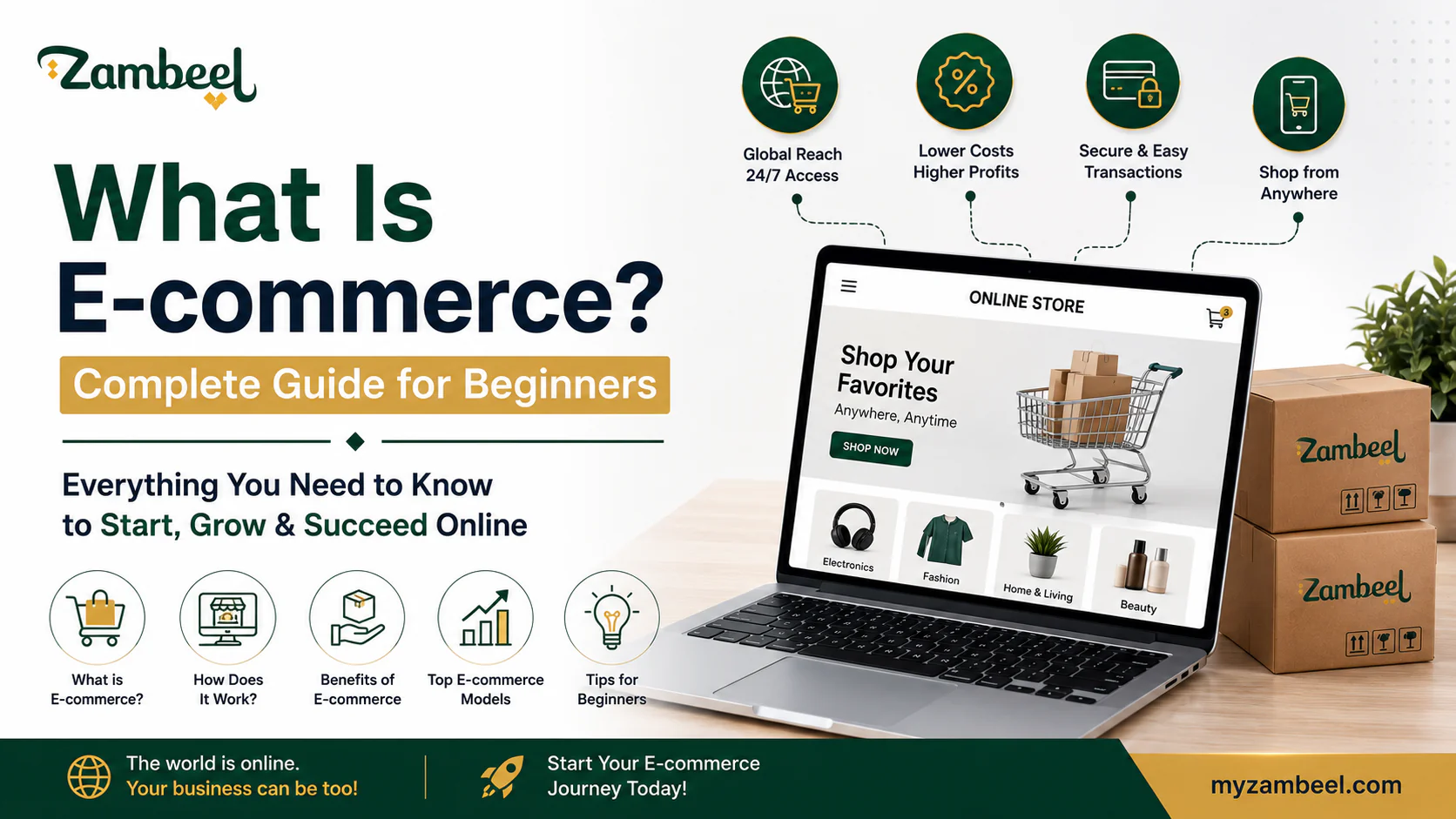
What Is E-commerce? A Complete Beginner’s Guide (2026)
Discover what e-commerce is, how it works, its different business models, benefits, challenges, and the essential steps to start and grow a successful online business in 2026.
What Is E-commerce? The Complete Beginner's Guide (2026)
Introduction
E-commerce has transformed the way people buy and sell products, making it easier than ever for businesses to reach customers worldwide. Whether you're purchasing clothes online, ordering groceries through a mobile app, or selling products from your own website, you're participating in the rapidly growing world of e-commerce.
In recent years, advancements in digital technology, secure payment systems, and global logistics have made online shopping more accessible than ever. Today, businesses of all sizes—from startups to multinational brands—use e-commerce to expand their reach, increase sales, and provide customers with convenient shopping experiences.
If you're considering starting an online business or simply want to understand how digital commerce works, this guide covers everything you need to know. You'll learn what e-commerce is, how it works, its different business models, advantages, challenges, and practical steps to build a successful online business.
Whether you're an entrepreneur, retailer, or aspiring online seller, understanding e-commerce is the first step toward taking advantage of one of the world's fastest-growing industries.
What Is E-commerce?
E-commerce, short for electronic commerce, refers to the buying and selling of goods and services over the internet. It also includes every digital process involved in completing a transaction, such as online payments, inventory management, marketing, shipping, customer support, and order fulfillment.
Unlike traditional retail stores that require customers to visit a physical location, e-commerce allows businesses to operate online through websites, marketplaces, or mobile applications.
Customers can browse products, compare prices, place orders, make secure payments, and track shipments without leaving their homes.
Today, millions of businesses rely on e-commerce to reach customers across local and international markets, making it one of the most important business models in the digital economy.
Simple Definition
E-commerce is the process of buying and selling products or services online using websites, mobile apps, or digital marketplaces.
Learn E-commerce with Zambeel.
How Does E-commerce Work?
Although online shopping seems simple from a customer's perspective, several processes work together behind the scenes.
1. Product Listing
Businesses upload product information, descriptions, pricing, and images to their online stores or marketplaces.
Customers browse products using categories, search functions, or recommendations.
2. Shopping Cart
After selecting products, customers add them to a shopping cart.
The cart calculates totals, taxes, discounts, and shipping fees before checkout.
3. Secure Checkout
Customers provide their shipping details and choose a payment method.
Common payment options include:
- Credit and debit cards
- Digital wallets
- Bank transfers
- Buy Now, Pay Later (BNPL)
- Cash on Delivery (COD)
For many countries in the Middle East, Cash on Delivery remains one of the most preferred payment methods, helping businesses reach customers who may not use online payments.
4. Payment Processing
Payment gateways securely process customer payments while protecting sensitive financial information through encryption and fraud prevention systems.
Once payment is approved, the order moves to fulfillment.
5. Order Fulfillment
Order fulfillment involves:
- Picking products
- Packing orders
- Labeling shipments
- Shipping packages
- Updating tracking information
As businesses grow, many choose to outsource fulfillment to third-party logistics (3PL) providers, allowing them to focus on sales and customer experience instead of warehouse operations.
6. Delivery
Shipping companies transport orders to customers.
Modern logistics solutions often include:
- Same-day delivery
- Next-day delivery
- International shipping
- Real-time order tracking
Fast and reliable delivery has become one of the biggest competitive advantages in e-commerce.
7. Customer Support
The customer journey doesn't end after delivery.
Successful e-commerce businesses provide:
- Returns and exchanges
- Warranty support
- Live chat
- Email assistance
- Order tracking
Excellent customer service increases repeat purchases and builds long-term customer loyalty.
Types of E-commerce
Not all online businesses operate in the same way. Different business models serve different audiences and goals.
1. Business-to-Consumer (B2C)
B2C is the most common form of e-commerce.
Businesses sell products or services directly to individual consumers.
Examples include:
- Clothing stores
- Electronics retailers
- Beauty brands
- Online grocery stores
Most people interact with B2C e-commerce every day when shopping online.
2. Business-to-Business (B2B)
In the B2B model, companies sell products or services to other businesses.
Examples include:
- Wholesale suppliers
- Manufacturers
- Software companies
- Industrial equipment providers
B2B transactions often involve larger order volumes and long-term business relationships.
3. Consumer-to-Consumer (C2C)
Individuals sell products directly to other individuals using online marketplaces.
Examples include:
- Used furniture
- Collectibles
- Handmade crafts
- Second-hand electronics
Marketplaces simplify transactions by connecting buyers and sellers.
4. Consumer-to-Business (C2B)
Consumers provide products or services to businesses.
Examples include:
- Freelance designers
- Content creators
- Photographers
- Influencers
- Consultants
The rise of freelancing platforms has significantly expanded this business model.
Why Is E-commerce Growing So Fast?
Several factors continue driving rapid growth across the global e-commerce industry.
Convenience
Customers can shop anytime without visiting physical stores.
Shopping is available 24 hours a day, seven days a week.
Wider Product Selection
Online businesses are not limited by shelf space.
Customers can access thousands of products from local and international sellers.
Mobile Shopping
Smartphones have changed buying behavior.
Many consumers now browse, compare, and purchase products directly from mobile apps.
Improved Payment Options
Modern payment technologies have made online shopping more secure and convenient than ever.
Customers now have multiple payment choices that fit different preferences.
Better Logistics
Advancements in warehousing, fulfillment, and shipping allow businesses to deliver products faster while improving customer satisfaction.
Efficient logistics have become one of the key drivers of successful e-commerce businesses.
Growing Digital Adoption
More people are gaining access to the internet every year.
As internet usage increases globally, online shopping continues attracting new customers and creating opportunities for businesses of every size.
Benefits of E-commerce
E-commerce has become one of the most effective ways for businesses to grow because it removes many of the limitations of traditional retail. Whether you're launching a startup or expanding an established company, selling online offers numerous advantages.
1. Reach Customers Worldwide
Unlike physical stores that serve a local market, an e-commerce business can reach customers across cities, countries, and even continents.
With the right marketing strategy and reliable shipping solutions, businesses can expand into new markets without opening additional storefronts.
For example, a seller based in one country can serve customers across the GCC through efficient fulfillment and logistics partners.
2. Lower Operating Costs
Running an online store generally costs less than operating a traditional retail business.
Businesses can reduce expenses related to:
- Store rent
- Utilities
- In-store staff
- Physical displays
- Maintenance
These savings can be invested in marketing, product development, or improving customer service.
3. 24/7 Availability
One of the biggest advantages of e-commerce is that your store never closes.
Customers can browse products, place orders, and complete purchases at any time, regardless of time zones or business hours.
This allows businesses to generate sales even while the owner is offline.
4. Better Customer Insights
E-commerce platforms provide valuable data that helps businesses understand customer behavior.
You can track:
- Best-selling products
- Customer demographics
- Shopping patterns
- Conversion rates
- Traffic sources
- Cart abandonment
These insights make it easier to improve marketing campaigns and increase sales.
5. Easier Business Growth
As your business grows, you can add more products, serve more customers, and expand into new regions without significantly increasing operational costs.
Many businesses use fulfillment providers and third-party logistics (3PL) services to scale efficiently while maintaining fast and reliable deliveries.
6. Personalized Shopping Experience
Modern e-commerce platforms use customer data to create personalized experiences.
Examples include:
- Product recommendations
- Personalized discounts
- Email marketing
- Recently viewed items
- AI-powered search
Personalization improves customer satisfaction and increases repeat purchases.
Challenges of E-commerce
While e-commerce offers tremendous opportunities, it also comes with challenges that every business owner should understand.
Intense Competition
Starting an online business has become easier than ever.
As a result, businesses often compete with:
- Local stores
- Global brands
- Online marketplaces
- International sellers
Standing out requires high-quality products, excellent customer service, and effective digital marketing.
Building Customer Trust
Unlike physical stores, customers cannot touch or inspect products before purchasing.
Businesses must build trust by providing:
- Clear product descriptions
- High-quality images
- Transparent pricing
- Customer reviews
- Secure payment methods
- Easy return policies
Trust is one of the most important factors influencing online purchasing decisions.
Shipping and Logistics
Fast and reliable delivery is now an expectation rather than a luxury.
Businesses must manage:
- Inventory
- Warehousing
- Packaging
- Shipping
- Delivery tracking
- Returns
As order volumes increase, handling these operations internally can become complex. Many growing businesses choose fulfillment and 3PL providers to streamline operations and improve delivery performance.
Cybersecurity Risks
Protecting customer information is essential.
Businesses should invest in:
- SSL certificates
- Secure payment gateways
- Data encryption
- Fraud prevention systems
- Regular security updates
Strong cybersecurity helps protect both customer data and business reputation.
Cart Abandonment
Many customers add products to their shopping carts but leave without completing their purchase.
Common reasons include:
- Unexpected shipping costs
- Complicated checkout
- Limited payment options
- Slow website performance
Businesses can reduce cart abandonment by offering transparent pricing, simplified checkout, and multiple payment methods.
Popular E-commerce Business Models
Choosing the right business model is one of the most important decisions when starting an online business.
1. Dropshipping
Dropshipping allows entrepreneurs to sell products without holding inventory.
When a customer places an order:
- The seller receives the order.
- A supplier prepares the product.
- The supplier ships it directly to the customer.
Advantages
- Low startup costs
- No inventory management
- Lower financial risk
- Easy to test new products
Because of its flexibility, dropshipping has become one of the most popular ways to start an e-commerce business.
Learn How to start Dropshipping
2. Traditional Inventory Model
Businesses purchase inventory in advance and store products until customers place orders.
This model provides greater control over inventory and branding but requires higher upfront investment.
3. Wholesale
Wholesale businesses sell products in bulk to retailers or other businesses.
This model typically involves:
- Larger order values
- Long-term business relationships
- Lower profit margins per unit
- Higher overall sales volume
4. Private Label
Private label businesses source products from manufacturers and sell them under their own brand name.
This approach allows companies to build unique brands while maintaining better control over pricing and customer experience.
5. Print-on-Demand
Print-on-demand businesses customize products such as:
- T-shirts
- Hoodies
- Mugs
- Phone cases
- Posters
Products are printed only after customers place an order, reducing inventory costs.
6. Subscription Commerce
Customers pay recurring fees to receive products on a regular schedule.
Examples include:
- Coffee subscriptions
- Beauty boxes
- Meal kits
- Pet supplies
- Vitamins
Subscription models provide predictable recurring revenue for businesses.
Choosing the Right E-commerce Platform
Selecting the right platform is essential for long-term success.
Here are some popular options:
Zambeel
Zambeel is Ideal for begginers, online sellers, entrepreneurs and businesses looking to simplify e-commerce operations and expand across GCC markets.
Offers:
- Dropshipping solutions with access to a wide product catalog
- Warehousing and inventory management services
- Order fulfillment, including picking, packing, and shipping
- Cash on Delivery (COD) support for selected markets
- Third-party logistics (3PL) solutions for scalable operations
- Support for businesses selling across the UAE, Saudi Arabia, Qatar, Bahrain, Oman, and Kuwait.
-
Shopify
Ideal for beginners and growing businesses.
Offers:
- Easy store setup
- Secure payments
- Mobile-friendly themes
- Extensive app marketplace
WooCommerce
Perfect for businesses using WordPress.
Benefits include:
- Full customization
- SEO-friendly structure
- Large plugin ecosystem
- Strong community support
Magento (Adobe Commerce)
Designed for large enterprises requiring advanced customization and scalability.
BigCommerce
Suitable for medium and large businesses looking for built-in features and multi-channel selling capabilities.
Marketplace Selling
Some businesses choose to sell through online marketplaces in addition to their own websites.
This strategy can increase visibility while helping businesses reach new customers.
However, having your own online store provides greater control over branding, customer relationships, and long-term growth.
How to Start an E-commerce Business
Starting an e-commerce business is more than simply creating a website and listing products. Success comes from careful planning, choosing the right business model, and delivering an excellent customer experience.
Follow these steps to build a strong foundation for your online business.
Step 1: Choose a Profitable Niche
A niche is a specific segment of the market that focuses on particular products or customers.
Instead of trying to sell everything, successful e-commerce businesses often specialize in a category such as:
- Fashion
- Electronics
- Home décor
- Health and beauty
- Pet supplies
- Fitness equipment
- Baby products
When selecting a niche, consider:
- Market demand
- Competition
- Profit margins
- Customer pain points
- Long-term growth potential
Choosing the right niche makes marketing more effective and helps establish your brand as an authority.
Step 2: Research Your Target Audience
Understanding your customers is essential.
Ask questions such as:
- Who are they?
- What problems are they trying to solve?
- What products are they searching for?
- Which platforms do they use?
- What influences their buying decisions?
The better you understand your audience, the easier it becomes to create products, content, and marketing campaigns that convert visitors into customers.
Step 3: Select Your Business Model
Before launching your store, choose the business model that best fits your goals.
Popular options include:
- Dropshipping
- Holding inventory
- Private label
- Wholesale
- Print-on-demand
- Subscription commerce
Each model has different investment requirements, profit margins, and operational responsibilities.
Step 4: Build Your Online Store
Your website is your digital storefront.
Choose an e-commerce platform that matches your business needs and create a professional, user-friendly shopping experience.
A successful online store should include:
- Fast loading speed
- Mobile-friendly design
- Clear product categories
- High-quality product images
- Detailed product descriptions
- Secure checkout process
- Easy navigation
A well-designed website helps build customer trust and improves conversion rates.
Step 5: Add Secure Payment Methods
Customers expect convenient and secure payment options.
Depending on your market, consider offering:
- Credit and debit cards
- Digital wallets
- Bank transfers
- Buy Now, Pay Later (BNPL)
- Cash on Delivery (COD)
Providing multiple payment methods reduces checkout friction and improves the shopping experience.
Step 6: Plan Your Inventory and Fulfillment
Efficient inventory management and order fulfillment are essential for customer satisfaction.
As your business grows, manually handling storage, packing, and shipping can become time-consuming. Many e-commerce businesses work with fulfillment and third-party logistics (3PL) providers to streamline operations, improve delivery speed, and focus more on sales and customer service.
Reliable fulfillment also helps reduce shipping delays and supports business growth across multiple markets.
Step 7: Promote Your Business
Launching your website is only the beginning.
To attract customers, invest in digital marketing strategies such as:
- Search Engine Optimization (SEO)
- Content marketing
- Email marketing
- Social media marketing
- Pay-per-click (PPC) advertising
- Influencer collaborations
Combining multiple marketing channels helps generate consistent traffic and increase sales.
E-commerce SEO Best Practices
Search Engine Optimization (SEO) helps your online store appear in search engine results when potential customers search for products or information.
A strong SEO strategy can drive long-term organic traffic without relying entirely on paid advertising.
Perform Keyword Research
Identify keywords that your audience uses when searching online.
Examples include:
- What is e-commerce
- Online business
- E-commerce platform
- Online store
- Dropshipping
- E-commerce fulfillment
Use one primary keyword per page and support it with relevant secondary keywords.
Optimize Your Product Pages
Each product page should include:
- Unique product title
- Detailed description
- Optimized images
- Internal links
- Customer reviews
- Relevant keywords
Avoid copying manufacturer descriptions, as unique content performs better in search results.
Improve Website Speed
Website speed directly affects user experience and search rankings.
Optimize:
- Images
- Caching
- Code
- Hosting
- Mobile performance
A fast website encourages visitors to stay longer and complete purchases.
Create Helpful Content
Publishing educational blog articles helps attract potential customers before they are ready to buy.
Examples include:
- Buying guides
- Product comparisons
- Industry trends
- How-to articles
- Frequently asked questions
High-quality content establishes authority and supports long-term SEO performance.
Build Internal Links
Link related pages throughout your website.
For example, an educational article about e-commerce can naturally direct readers to content about dropshipping, order fulfillment, warehousing, or logistics solutions.
Internal linking improves navigation, distributes page authority, and helps search engines understand your website structure.
Common E-commerce Mistakes to Avoid
Many new businesses make avoidable mistakes that slow their growth.
Some of the most common include:
Ignoring Mobile Users
A significant percentage of online purchases are made on smartphones.
Your website should be fully responsive and easy to navigate on all devices.
Poor Product Descriptions
Generic descriptions often fail to answer customer questions.
Write clear, informative, and original descriptions that explain product features, benefits, and specifications.
Complicated Checkout Process
A lengthy checkout process can lead to abandoned carts.
Keep checkout simple by minimizing unnecessary steps and offering guest checkout where appropriate.
Weak Customer Support
Customers expect quick responses and helpful assistance.
Providing live chat, email support, or comprehensive FAQs can improve customer satisfaction and encourage repeat business.
Neglecting SEO
Without SEO, your website may struggle to attract organic traffic.
Regularly update your content, optimize your pages, and monitor keyword performance to maintain visibility in search results.
The Future of E-commerce
The e-commerce industry continues to evolve as technology and consumer expectations change.
Several trends are shaping the future of online business:
- Artificial intelligence (AI) for personalized shopping experiences
- Voice search optimization
- Mobile-first shopping
- Faster delivery options
- Social commerce through platforms like Instagram and TikTok
- Sustainable packaging and eco-friendly practices
- Omnichannel retail experiences
- Advanced automation for inventory and order management
Businesses that adapt to these trends will be better positioned to meet customer expectations and remain competitive.
Frequently Asked Questions
What is e-commerce?
E-commerce is the process of buying and selling products or services online through websites, mobile applications, or digital marketplaces.
Is e-commerce profitable?
Yes. With the right products, marketing strategy, customer service, and operational efficiency, e-commerce can be a highly profitable business model.
What is the difference between e-commerce and dropshipping?
E-commerce is the broader concept of selling products or services online. Dropshipping is one e-commerce business model in which the seller does not keep products in stock but relies on a supplier to fulfill customer orders.
What are the main types of e-commerce?
The four primary types are:
- Business-to-Consumer (B2C)
- Business-to-Business (B2B)
- Consumer-to-Consumer (C2C)
- Consumer-to-Business (C2B)
Why is SEO important for e-commerce?
SEO helps businesses increase their visibility in search engines, attract qualified organic traffic, reduce advertising costs over time, and improve long-term online growth.
Conclusion
E-commerce has fundamentally changed how businesses connect with customers, offering opportunities to reach wider audiences, reduce operating costs, and scale more efficiently than traditional retail. Whether you're starting your first online store or expanding an existing business, success depends on choosing the right business model, understanding your customers, and delivering a seamless shopping experience.
Building a successful e-commerce business also requires more than great products. Reliable payment options, effective digital marketing, strong SEO, and efficient order fulfillment all contribute to long-term growth. As order volumes increase, many businesses streamline their operations by working with fulfillment and 3PL providers that handle warehousing, inventory management, packing, and shipping, allowing them to focus on serving customers and growing their brand.
By applying the strategies outlined in this guide and continuously adapting to changing market trends, you'll be well positioned to build a sustainable and competitive e-commerce business in 2026 and beyond.